Banner K100 Programmable Display Beacon for Smart Factory Automation
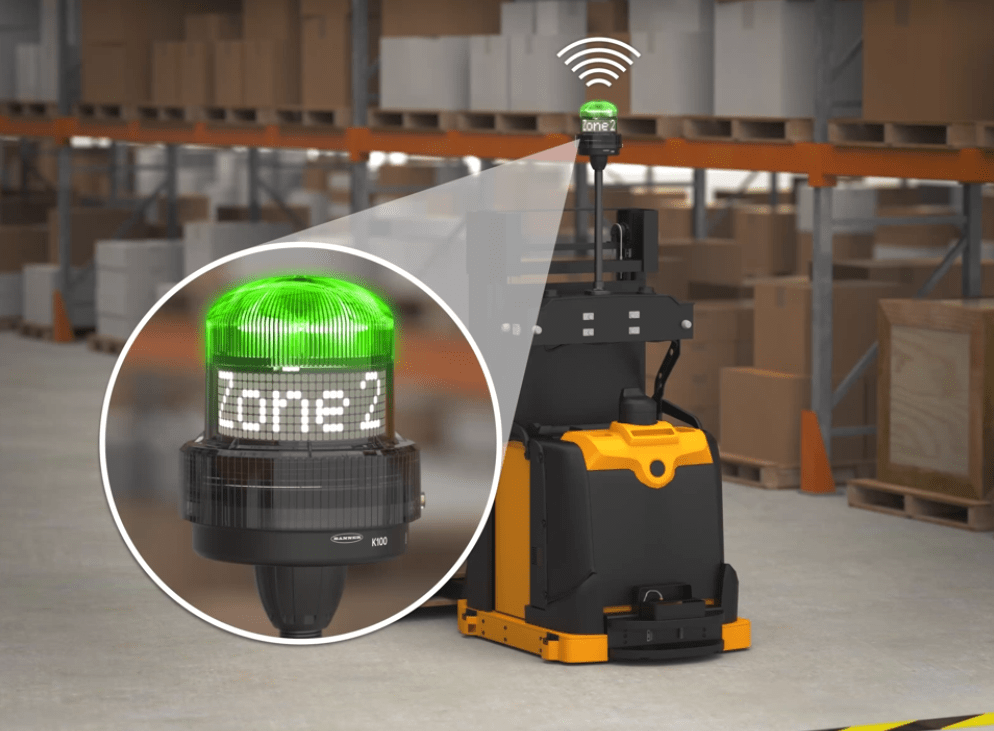
(Source: Banner Engineering)
In today’s advanced manufacturing environments, simply having machines that perform well is no longer enough. Operators, engineers, and safety teams must understand what is happening and what needs immediate action, often with only a glance. This means that having equipment that features a clear and understandable user interface (UI) is no longer a "nice to have," but a safety and productivity imperative.
Visual indicators are beginning to move beyond static lights and signals; they convey status, urgency, and instruction in environments filled with distractions, noise, and complexity. In high-automation factories where robots, conveyors, and sensors are all active, the failure of a visual indicator is rarely just a “missed signal." Instead, it can translate into downtime, waste, or accidents.
At the same time, automation trends mean signaling systems must change as fast as the lines they support. As adaptive manufacturing becomes more prominent, modular cells and reconfigurable systems are creating new requirements for the next generation of industrial automation. To meet the demands of today’s automated environments, designers must inject programmability, clarity, and integration into the heart of their UI designs.
Specific UI Requirements for Industrial Automation
Industrial automation demands a unique approach to interface design: one that balances clarity, durability, and adaptability in environments where distraction, complexity, and risk are part of everyday operation. This new approach means equipment UI must overcome a number of challenges.
The Need to Work Around Automation and Distractions
Automated environments bring speed, but also complexity. Multiple processes run simultaneously. Operators may have to monitor several machines at once. Alarms can blend into the ambient noise of conveyance, motors, and fans. In such settings, a signal must cut through. Getting the right attention is not just about the signal’s brightness, it is about relevance. A well-designed UI uses color, display text, and animation intelligently so the right person knows what to do and when to do it.
Difficult Factory Conditions and Environmental Demands
Industrial UI components must survive vibration, dust, high thermal variation, electromagnetic interference, and potentially wash-down environments as well. A beacon that is too dim, wrongly colored, or not visible at oblique angles or in direct sunlight is more of a liability than an asset. Incomplete or confusing signals can delay response times, which can increase machine downtime or create safety hazards.
Shifting from Fixed to Dynamic Signaling
With the addition of new product lines, the use of modular sensors, and advanced industrial Internet of Things (IIoT) integrations, today’s factories need the ability to reconfigure rapidly. Part of this involves the signaling system keeping pace with a world where machine state, operator role, and process stage may change overnight. UI design must now support programmability, remote updates, and dynamic context. In other words, automation systems demand automation in UI in order to truly deliver the benefits of streamlined operations.
Banner K100 Programmable Display Beacon
The K100 Programmable Display Beacons from Banner Engineering brings this new UI paradigm into focus. It merges multicolor beacon visibility with a dynamic alphanumeric display, delivering status indication and instruction in one compact device (Figure 1).
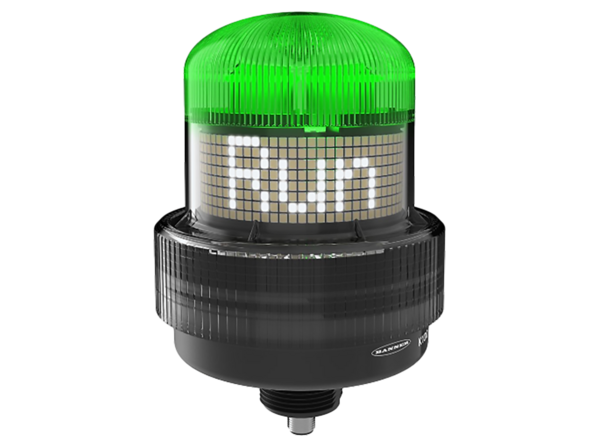
Figure 1: Banner K100 Programmable Display Beacon showing green illumination and scrolling text for normal operation. (Source: Mouser Electronics)
Banner K100 Programmable Display Beacon Series features that are critical to an industrial automation environment include:
- 14 configurable color options allow signaling to differentiate finely between states, faults, and process phases.
- Alphanumeric display of up to 32 scrolling characters legible from roughly 10 meters away, providing needed contextual information along with high visibility.
- Rugged ratings (IP66/IP69K) ensure the device can survive harsh factory conditions, including dust, moisture, and impact.
- Flexible integration with discrete models using Pro Editor software for local configuration or fully networked communication via IO-Link or Modbus for remote control and dynamic changes.
Integration into Automation Systems
Because many modern systems use IIoT platforms, programmable logic controller (PLC) networks, and smart alerts, the K100 Programmable Display Beacon fits seamlessly into today’s automated ecosystems. It can be configured to respond to machine signals, PLC outputs, and even cloud-based condition monitors, enabling an indicator to reflect real-time process health, part-refill status, and safety warnings. One prime application for the K100 Programmable Display Beacon is part-refill indication in assembly-cell environments, providing both visibility and clear, actionable alerts.
Engineering Benefits
For an automation engineer, the benefits of the K100 Programmable Display Beacon Series are clear: Fewer custom light towers, reduced need for field rewiring when lines change, and lower margin for error in operator response. The K100’s dynamic display means that rather than just flashing red, the device might show text such as "CHECK MOTOR TEMP" or "REFILL PARTS 2 MIN," demonstrating far richer signaling (Figure 2). This leads to faster operator action, fewer false stops, and better responsiveness to change.
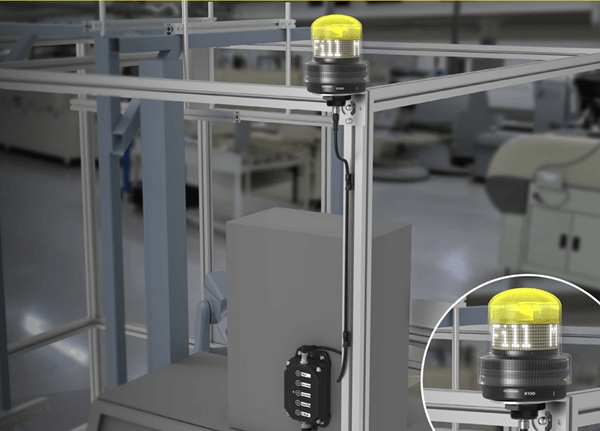
Figure 2: K100 Programmable Display Beacon mounted on industrial equipment, providing real-time process signaling and safety status indication. (Source: Banner Engineering)
In assembly-cell operations, operators often manage multiple machines and part-refill points simultaneously. Banner Engineering’s K100 Programmable Display Beacon enables clear visual, text, and audible alerts that indicate which part needs refilling and where. This helps reduce confusion and improves response coordination across high-volume production lines.[1]
Conclusion
The pace of automation does not rest, and neither should the signaling systems that support automation. Modern automation requires programmable, connected indicators that can keep up with shifting processes and data. The K100 Programmable Display Beacon Series from Banner Engineering offers a platform designed for today's needs: high visibility, contextual signaling, and integration into the smart factory. For engineers seeking both clarity and flexibility in machine status indication, this device is a compelling solution.
As automation advances, visual communication must keep up. The UI is not an afterthought, it is the signal everyone watches. The right device does not just warn, it guides, alerts, and informs.
Sources
[1]https://www.bannerengineering.com/us/en/applications/status-indication/k100-programmable-display-beacon-for-part-refill---status.html
Author
 Lauren Gibbons Paul has been a business/enterprise technology writer and editor in the Boston area for 25 years, working for clients such as SAP, MIT Technology Review Custom, MIT Sloan Management Review Connections, and MIT News. In the past year, she has written thought leadership pieces on industrial automation and enterprise technology topics, including cloud, enterprise security, AIops, MLops, and edge technologies.